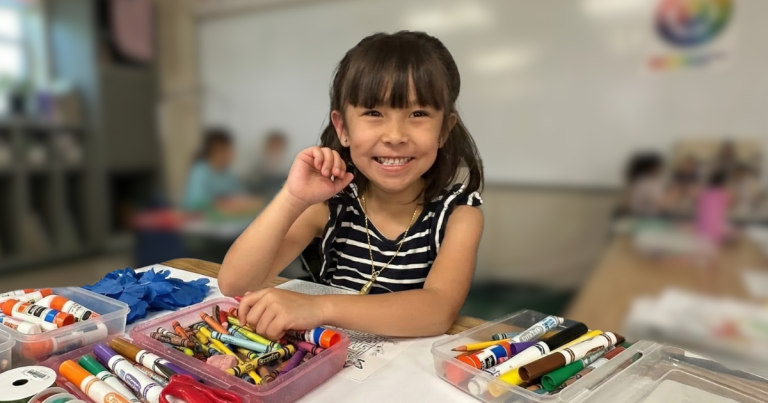
Why We’re Homeschooling: The School Just Failed to See Her
My daughter Sophia made herself sick every morning before school. Not dramatic sick. Not faking it. Stomach aches, headaches, waking up already…
My daughter Sophia made herself sick every morning before school. Not dramatic sick. Not faking it. Stomach aches, headaches, waking up already wound tight, already bracing for something. And every night before bed, she cried. This is why we’re homeschooling.
She wasn’t the kid who got sent to the office. She was the quiet one. The daydreamer. The one who was caring with classmates, didn’t disrupt learning, and smiled enough that nobody raised a flag.
That’s exactly the problem.
I’m Nicole Phommanorat and this is the post where I explain how we ended up here. Opting out of public and traditional American schooling and starting over at home in August 2026. It’s not a rage quit. It’s not a lifestyle trend. It’s what happens when you spend two years trying to work with a system that doesn’t have the capacity to see your kid.
The Report Cards Didn’t Match the Child We Knew
Sophia’s report cards said she couldn’t tell a story. Didn’t know her letters. Couldn’t do simple math.
That wasn’t the kid we had at home.
At home, Sophia built elaborate imaginary worlds with rules and characters and storylines that ran for weeks and would give K-Drama a run for its money. She narrated. She negotiated. She remembered things in detail most had long forgotten. She was funny and intense and deeply, deeply curious about how everything worked.
The school was seeing something completely different.
I spent a long time wondering if I failed in preparing her for school. Maybe I was too busy trying to take care of everyone else. Maybe I was neglecting to teach her the basics she needed to be successful. It felt like everyone, her pediatrician, her dentist, and our family, commented frequently on how intelligent she was. So we did what you’re supposed to do. We sought evaluations through the school district. We got pediatrician referrals. We asked the right questions and filled out the right forms. A lot of forms.
What we found was that the school was over capacity. We knew when she started kindergarten that her elementary school was way over capacity. They didn’t have enough classrooms. There were modular temporary buildings out front and out back. Her kindergarten teacher wasn’t hired until the first day of school. There were teacher shortages. Substitutes running classrooms. Teachers quitting mid-year, classrooms being combined. The staff at her elementary school are all wonderful people doing the best they can with the resources they have. They care deeply for the children who attend. But they aren’t set up for success.
We ran into similar issues with our older children through the evaluation process. Consistent. The same people we were trying to get evaluations from were the same people who couldn’t keep up with the basics. The capacity just wasn’t there.
The school couldn’t see Sophia because the school didn’t have the capacity to see her.
What Was Actually Happening to Her
While we were navigating evaluations and referrals, Sophia was drowning quietly.
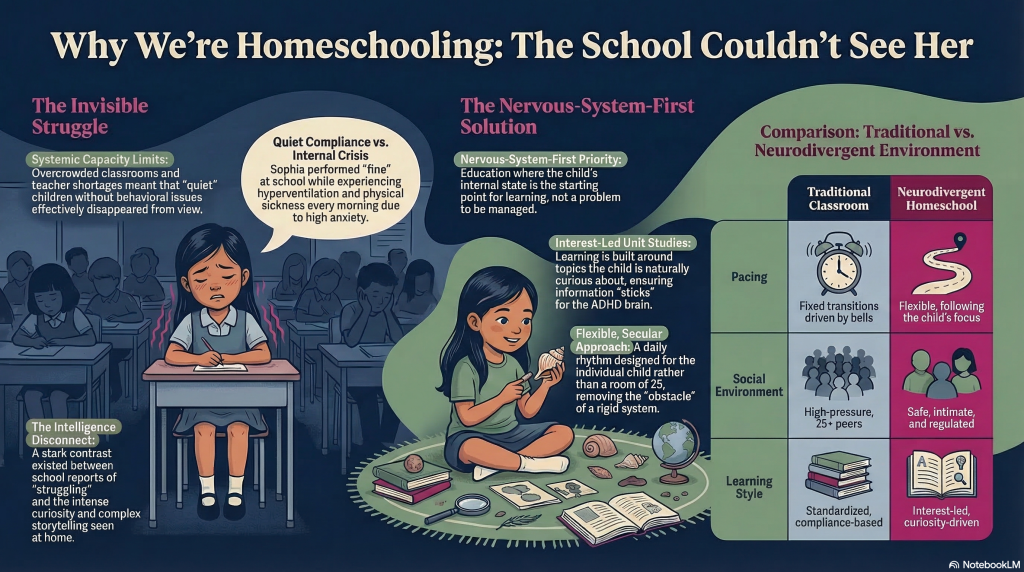
She was making herself physically sick with anxiety every single morning. She was worried about kids being rude, about her teacher not believing her. Sometimes she’d hyperventilate before school. Her teacher would report she had a good day and didn’t see anything that would trigger that reluctance. She was doing the thing that quiet, compliant, overlooked kids learn to do. She was performing fine while falling apart underneath.
We eventually got formal diagnoses. ADHD Combined Type and high anxiety. And a cognitive profile that made complete sense once someone actually looked. Verbal and visual strengths, working memory and processing speed as real areas of challenge.
The school had no idea because she wasn’t causing problems. She wasn’t disruptive. She was just disappearing.
How do we put her through this five days a week for the next twelve years? We couldn’t keep sending her somewhere that couldn’t see her. That was the whole thing. Not the curriculum, not the schedule, not some ideology about homeschooling being better. Just that. My kid was disappearing because she wasn’t disruptive enough to be noticed and the capacity to help her learn the way her brain works wasn’t there.
Why We Didn’t Just Try a Different School
We looked at other schools. We looked at what was available in our area. We looked at co-ops and hybrid programs. Most of what exists in Texas, at least where we are, is predominantly faith-based, and that environment doesn’t fit our family. So that door mostly closed. Nothing specifically for neurodivergent kids.
What we kept coming back to was this: Sophia doesn’t need a different version of the same system. She needs a different system. One where her nervous system isn’t the problem to be managed. One where the way her brain works, the intensity, the interest-driven learning, the need to actually care about something before she can absorb it, is the starting point, not the obstacle.
So this is why we’re homeschooling.
What This Actually Looks Like Starting August
We’re starting in August 2026. Sophia goes into 2nd grade. Leila starts kindergarten. We’re doing secular, interest-led unit studies, at least one field trip a month, and a daily schedule built around how their nervous systems actually work. Not how a classroom full of 25 kids needs them to work.
I’m also building a documentation system for our family so what they’re learning doesn’t disappear into a camera roll at the end of the year. I’ll share more about that as we get closer.
This blog, Raise & Rise at nicolephom.com, is where I’m documenting all of it. Not the highlight reel. The actual thing. The days it works and the days it doesn’t and everything I’m learning in between.
We’re figuring this out. Come watch.
Frequently Asked Questions
How do you know when it’s time to pull your kid from school?
For us it wasn’t one moment. It was a pattern. Sophia making herself sick with anxiety every morning, crying every night before bed, and report cards that described a child we didn’t recognize at home. When the environment is consistently costing your kid more than it’s giving them, that’s worth paying attention to. You don’t have to wait until it becomes a crisis.
Do you have to have a teaching background to homeschool?
No. You need to know your kid, and you already know them better than anyone in a classroom of 25 does. In Texas, the legal bar to homeschool is accessible. You don’t need a credential. The harder part is building a daily rhythm that works for your actual family, not a version of traditional school at home.
What if my child has ADHD and I’m not sure they can learn at home?
Most ADHD kids struggle in traditional classroom environments. The constant demand to sit still, transition on a bell, and engage with material on someone else’s timeline is genuinely hard on an ADHD nervous system. At home you can build in movement, follow interest, and pace things to how your kid actually absorbs information. It’s not easier. It’s just different hard. Why we’re homeschooling may not be your why, and that’s ok.
What curriculum do you use for a neurodivergent homeschooler?
We’re using a secular, interest-led unit studies approach. We build learning around topics Sophia and Leila are actually curious about rather than following a boxed curriculum. For neurodivergent kids especially, genuine interest is what makes information stick. We’re developing our own curriculum and will eventually layer in existing resources as they get older.
Still figuring out most of it. But we start in August and I’m not second-guessing that part anymore.
If you’re somewhere in the middle of this same decision, I’m glad you found this. Send me a message at hello@nicolephom.com. I read everything.