
ADHD Sensory Overload Was Hiding on Her Report Card. Here’s What 5,000 Kids’ Data Revealed.
Sophia’s report card said she couldn’t identify the beginning, middle, and end of a story. Couldn’t name the plot. Couldn’t describe the…
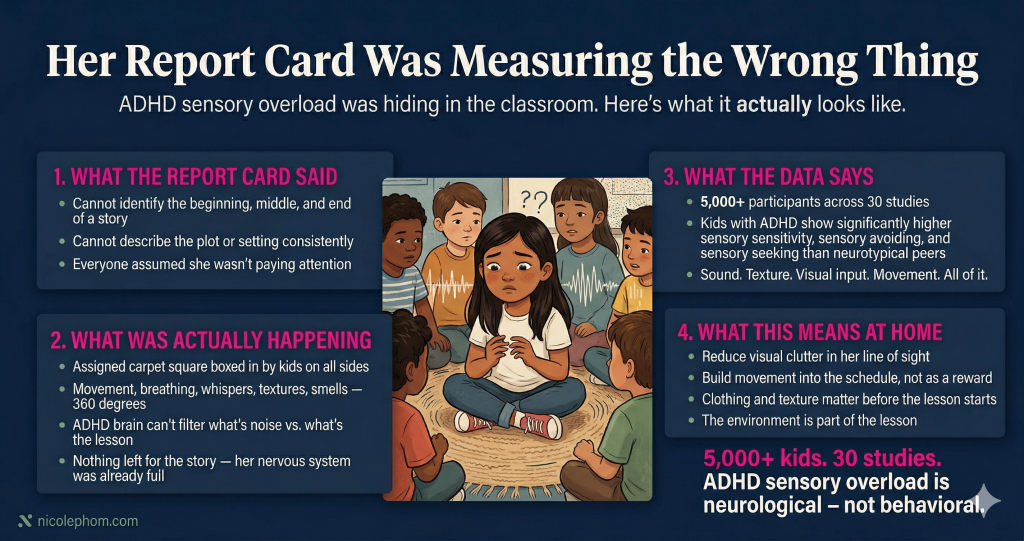
Sophia’s report card said she couldn’t identify the beginning, middle, and end of a story. Couldn’t name the plot. Couldn’t describe the setting consistently.
I read it and felt frustrated. And honestly, angry. Not at Sophia. At all of it. She’d been through so much this year, and the year before, and she still wasn’t getting what she needed out of being there. I started to wonder if I was sending her somewhere to actually learn or just to stand in lines and exist in a building.
If your kid has gotten a comment like that on their report card, you know the feeling. There is something missing. There is a disconnect. What I didn’t know yet was that ADHD sensory overload was a big part of why her teacher couldn’t see what she actually knew.
Then I had a conversation with her teacher. And I found out where Sophia was sitting during read-aloud time. And everything shifted.
What Was Actually Happening in That Classroom
She was assigned a square on a woven carpet in the middle of the group. A kid directly in front of her, one behind her, one on each side.
Movement 360 degrees around her.
The carpet itself was layered with fibers and colors, the kind you can feel even when you’re not trying to. Shoes on. Different textures on different kids’ shoes, different fabrics on different kids’ clothes, different hair. The sound of breathing. Occasional whispers. And whatever else is in the air when twenty-plus kids are packed into a room together.
She was supposed to be listening to a story in all of that.
She wasn’t failing to follow the story. She couldn’t even get to the story. Her nervous system was working overtime just to be in that environment.
What Does ADHD Sensory Overload Actually Look Like in the Classroom?
This isn’t about being sensitive or dramatic. Kids with ADHD process sensory input differently. Their nervous systems can be more reactive to sound, texture, visual noise, and movement, often all at once.
And unlike a kid who can filter out background stuff, an ADHD brain doesn’t automatically sort what’s important from what’s noise. So the story being read aloud is competing with the breathing sounds and the scratchy carpet and the kids shifting positions around her. Her brain is trying to process all of it. There’s nothing left for the plot.
When I started looking into ADHD sensory overload specifically, I found a research journal that looked at over 5,000 participants across 30 studies and found that kids with ADHD consistently showed higher sensory sensitivity, more sensory avoiding, and more sensory seeking than kids without ADHD. Sound, texture, visual input, movement. All of it. Sophia isn’t struggling to focus because she isn’t trying. She was sitting in the middle of a sensory environment that her nervous system couldn’t filter, and nobody thought to ask why. She isn’t disruptive, so no one noticed.
I Know What This Feels Like Because I Live It Too
I didn’t have language for any of this until recently. But the things I do to stay focused are not accidental.
I have fidgets in my car. Not because I’m bored. Because having something to do with my hands while I’m driving or thinking keeps me regulated. If I go to a networking event, I make sure I have something to fidget with. I’ll even wear specific clothing I know has a texture I can touch or mess with when I know I need to be locked in and paying attention.
I figured all of that out on my own over years, quietly, because nobody told me what I was doing or why it worked.
Sophia hasn’t had that time. She’s seven. She doesn’t have a catalog of coping strategies she’s built up slowly over a few decades. She just has a carpet square surrounded by kids and a teacher asking her to recall a plot point.
She can tell you the beginning, middle, and end of a story. When she’s actually able to hear it, when the environment isn’t competing for every thread of her attention, she’s right there. She gets it. She retains it.
Her report cards are measuring her tolerance of her environment. Not her ability.
If you’re trying to figure out why homeschooling might be worth considering for your kid, that distinction is worth sitting with. I wrote more about what pushed us toward this decision in Why We’re Homeschooling: The School Just Failed to See Her.
What Does This Mean for Our Homeschool Space?
We’re not working with a dedicated classroom. We have a shared living space, and that’s what we’re working with. I’m not going to pretend that’s perfect or that I’ve sorted it out.
But knowing what I know now, I can’t think about the space as just a backdrop. It’s part of the lesson before the lesson even starts. ADHD sensory overload doesn’t wait for instruction to begin. It starts the second she walks into the room. How we structure our day and routine matters.
I’m thinking about visual distractions and what we can reduce in her line of sight during focused work. I’m thinking about where she sits and whether she’s going to have too much happening in her peripheral vision. I’m thinking about clothing, specifically whether texture is going to be a distraction before we even open a book. I’m thinking about how noisy our busy home is during learning times.
I’m thinking about movement. She needs to move to focus, not after, not as a reward. The movement is part of how she processes. The schedule has to account for that, not treat it like an interruption that needs to be managed or taken away as a consequence.
And honestly, I’m thinking about myself too. I’m the one managing this environment while also being in it. If my own nervous system is already overloaded, the plan falls apart before it starts. Part of what I want her to learn isn’t just content. It’s herself. What she needs to focus, how to set up her space for it, and how to ask for it when she can’t do it alone.
None of this is figured out. August is still months away. But I’m asking better questions now than I was when I was just reading report cards and feeling angry.
Frequently Asked Questions
Does ADHD sensory overload affect a child’s ability to learn in a traditional classroom?
Yes. Kids with ADHD often process sensory input differently than neurotypical peers, with higher sensitivity to sound, texture, visual noise, and movement. In a typical classroom, that competing input can make it genuinely hard to access the actual lesson, even when a child is trying to pay attention. The environment itself can be the barrier.
How do I know if my ADHD kid is struggling with sensory overload or just not paying attention?
Look for inconsistency. If your child can recall information or demonstrate a skill in one setting but not another, the environment may be the variable. Ask what the physical setup looks like when they’re struggling. Seating location, sound level, visual clutter, and how many people are nearby all matter more than most report cards will tell you.
Does homeschooling help with ADHD sensory issues in the classroom?
It can, because you have more control over the environment than a traditional classroom allows. You can reduce visual clutter, adjust seating, allow movement, and tailor sensory input to what your specific child actually needs. It’s not automatic, and shared living spaces have their own challenges, but the variables are yours to manage. Homeschooling isn’t the only option either. If you think sensory issues are affecting your kid, start by talking to the school and your pediatrician. There are programs and adjustments available inside traditional school that can help.
What does a sensory-friendly homeschool space look like for an ADHD child?
It doesn’t require a dedicated room or a perfectly built-out setup. It looks like reducing what’s visually competing for attention in the learning area, allowing flexible seating and movement during lessons, being thoughtful about clothing, texture, and sound. Often it’s less about what you add and more about what you remove.
Can an ADHD child who struggled in school learn the same material at home?
Yes. In many cases the struggle isn’t with the content, it’s with the environment the content is being delivered in. When the sensory load is manageable and the setup fits the child’s nervous system, comprehension often improves significantly. The skill was there. The classroom just couldn’t reach it.
I spent months trying to figure out what the disconnect was with Sophia’s learning. A big piece of it is the environment her lessons are in. Her surroundings are competing with instruction for her attention.
We’re not there yet. August is still ahead of us and I’m still figuring out what this actually looks like day to day in a shared living space with five kids in and out of the house and a life happening around us. But at least now I know what I’m designing around.
If your kid’s report card has a comment that doesn’t match who you know your child to be, it might be worth asking what the environment looks like.